Autopilots
Rudder Drive Hydraulics
Depth Sounder
Log and Temperature
Wind Instruments
Contact us:
North America
Outside N. America
This is the US site
change currency here
get
manual
get
brochures
articles
home
TECNAUTIC System-6 Overview
The best available Mono Cable System comprising
Fly-By-Wire Steering, Cockpit Instruments, Autopilots and Jumbo Displays. Three years
warranty.
|
Fly-By-Wire Steering: a steering wheel that holds the heading The Fly-By-Wire
Steering Wheel or the Joystick determines the rate of turn of the boat, not
the rudder angle.
With the
wheel or Joystick centered, the heading is held. The artificial
boat stability is a main aspect of Fly-By-Wire steering. The Sonic
Heading Gyro is the heart of the system: a gyro compass which is produced by TECNAUTIC since
1992. The Autopilot positions the rudder and activates the thrusters as
|
Slow Mode:
Forget complicated shift, throttle and
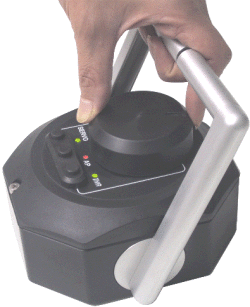 steering
wheel combinations in
close-quarter maneuvering.
Simply move the Joystick in the direction you want your boat to move. steering
wheel combinations in
close-quarter maneuvering.
Simply move the Joystick in the direction you want your boat to move. 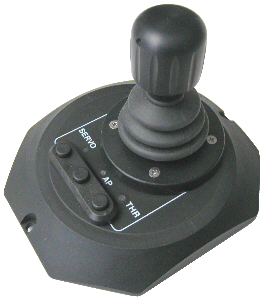 |
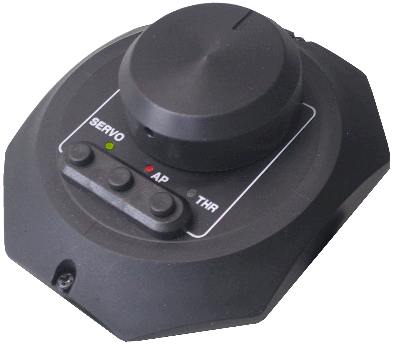 needed, so as to achieve the
requested turn rate of the boat, determined by the electronic wheel or
Joystick.
needed, so as to achieve the
requested turn rate of the boat, determined by the electronic wheel or
Joystick.  |
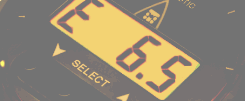
Cockpit Displays include analog color LED-pointer |
In addition to the digital LCD, an analog LED-pointer is included around the face of each cockpit display. Depending on the selected function, the analog LED pointer may work as a compass needle, wind angle indicator, amplified boat speed indicator, rudder angle, depth or trim flap indicator etc.
 |
Night time viewing and group wise illumination control |
The analog LED pointer can be dimmed
continuously down to zero and the LCD can be back lit for night time viewing.
When several displays are located in a group, e.g. in a forward cockpit, they can be
assigned the same group number. Adjusting the brightness of one of them will make the
others follow to the same brightness level.
A total of 15 groups can be created, with an unlimited number of displays in each group.
Tecnautic Displays offer more flexibility and more safety
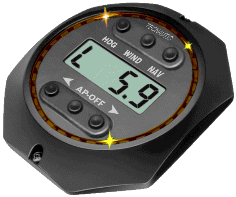
Each cockpit display can show all available data of the system, e.g. compass, log, wind, depth or GPS data etc. Data originating from Displays, Steering Wheels, Joysticks or Throttle Stations are distributed in the system over the network cable (CAN bus).
In addition to the bus connection, every display
unit can be individually connected to one analog and one digital sensor. For example, a
Sonic Heading Gyro can be connected to the "analog" input of a display and the
NMEA in- and output of a Flux Gate Sensor can be connected to the "digital"
input/output of a display unit.
 The sensor input can be unrelated
to the displayed function on that unit. A Sonic Heading Gyro for example can be connected
to a "Depth Display" or a Magnetic Compass Sensor can be connected to an
"Autopilot Display", if this makes the installation easier. As you realize
already, there is no "Depth Display" or "Compass Display" etc., they
are all technically equal, only the printing on the bezel and the number of key buttons
may be different.
The sensor input can be unrelated
to the displayed function on that unit. A Sonic Heading Gyro for example can be connected
to a "Depth Display" or a Magnetic Compass Sensor can be connected to an
"Autopilot Display", if this makes the installation easier. As you realize
already, there is no "Depth Display" or "Compass Display" etc., they
are all technically equal, only the printing on the bezel and the number of key buttons
may be different.
The size of the displays is 4.5 x 5.2 x 0.67 in. ( 114 x 132 x 17 mm). They are flush
mounted. Only a small hole in the center is required for installation.
A display unit that receives signals from a directly connected analog sensor or NMEA-data
from a directly connected digital sensor, will transmit these data at high speed to all other displays, steering wheels and the autopilot on the bus. A display
unit receiving data over the bus can output them via its digital NMEA-output, if desired.
There is no central processor in the system. Instead there is distributed functionality.
 Very Large
Instruments: Very Large
Instruments: The JUMBO displays offer 40 mm digit height (1.5 inches). They are available in fluorescent red or yellow. They can be set to display any parameter in the system. With two water tight network connectors at the back side, daisy chaining of multiple units becomes easy. The integrated illumination can be adjusted remotely from a cockpit display unit. The price of the TECNAUTIC JUMBO displays is unmatched. |
Silent and power saving
Two Autopilot Drive-Boxes can be installed to drive two pumps, either alternating or parallel, in
an augmentation mode, where the second pump starts only when a higher rudder
speed is needed.
In Docking Mode with individually steered rudders or stern or pod
drives, the Drive-Boxes will command individual steering angles.
On larger vessels, where constant hydraulic pressure
is available, the same Autopilot can drive electric servo valves or
proportional valves instead of the rudder motor.
One FADEC-Box for each engine controls the throttle and shift and -
depending on the model - the Trolling Valve and engine start circuit. Clutch
engagement is always gentle, with no rocking. With a trolling valve
installed, clutch pressure is increased steadily, not abruptly.
Bus Cable: cannot be disturbed
Fly-By-Wire steering, instruments, autopilot and engine controls are connected with identical cable. The cable has two wire pairs, one for data and one for the supply. If custom wiring is selected, branching of the bus cable is accomplished with RJ-45 connectors. These can be installed with a simple crimp tool. Standard cables are shipped with connectors already installed.
The TECNAUTIC network is based on a time driven CAN© protocol. It has a so called Multi Master Architecture and it guarantees data transmission within a defined time. Most other protocols slow down when an increasing number of nodes (equipment pieces) is connected to the bus. Not so the Tecnautic CAN bus. Transmission speed is 125 kbit/s. The distance between any two nodes on the bus may be up to 700 ft.